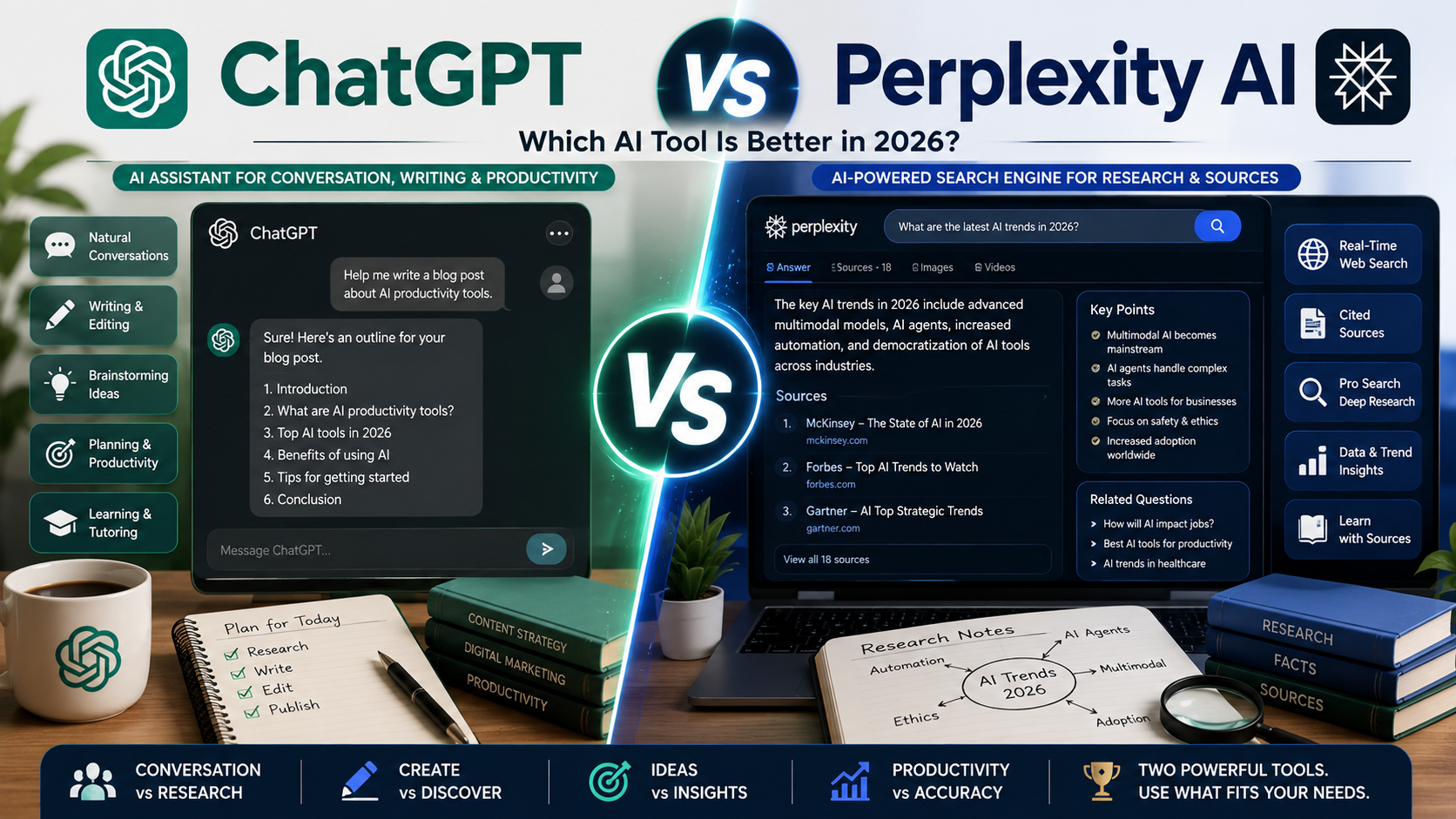
ChatGPT vs Perplexity AI: Which AI Tool Is Better in 2026?
Choosing between ChatGPT vs Perplexity AI can be difficult because both platforms can answer questions, research topics, explain complicated ideas and help you work more efficiently.
However, they are not identical tools.
Perplexity describes itself as an AI-powered search engine that searches the web and produces conversational answers supported by sources. ChatGPT is better understood as a broader AI assistant capable of handling many different kinds of conversational and productive work.
That difference can have a major impact on which platform is better for you.
In this guide, we’ll compare ChatGPT and Perplexity across 15 practical areas, including research, writing, learning, brainstorming, current information and everyday productivity.
By the end, you’ll have a much clearer idea of which one belongs in your AI toolkit.
ChatGPT vs Perplexity AI: Quick Comparison
| Feature | ChatGPT | Perplexity AI |
|---|---|---|
| General AI assistance | Excellent | Very good |
| Web research | Excellent | Excellent |
| Source-focused research | Very good | Excellent |
| Writing | Excellent | Good |
| Brainstorming | Excellent | Good |
| Long conversations | Excellent | Good |
| Current information | Excellent with web access | Excellent |
| Research citations | Very good | Excellent |
| Learning | Excellent | Very good |
| Content creation | Excellent | Good |
| Productivity | Excellent | Very good |
| Comparing sources | Very good | Excellent |
| Creative tasks | Excellent | Good |
| Quick factual research | Excellent | Excellent |
| Best overall use | Versatile AI assistant | Research-focused AI search |
The most important difference isn’t simply which platform has the most features.
It is how you intend to use AI.
What Is ChatGPT?
ChatGPT is a general-purpose AI assistant developed by OpenAI.
Rather than limiting itself to search, it can assist with writing, brainstorming, research, learning, planning, analyzing information and many other tasks.
You can ask follow-up questions and continue developing an idea through a conversation rather than treating every question as an isolated search.
For beginners, that versatility is one of ChatGPT’s biggest advantages.
You don’t necessarily need several specialized AI tools when one assistant can help across many different areas.
If you’re new to using ChatGPT effectively, read our guide on how to use ChatGPT for productivity.
What Is Perplexity AI?
Perplexity takes a more research-centered approach.
The company describes the platform as an AI-powered search engine that searches the web and produces conversational answers backed by sources.
Instead of receiving a traditional page containing ten blue links, you can ask a question and receive a synthesized response along with citations that allow you to investigate the original sources.
Perplexity also offers more advanced research options.
Its Pro Search feature conducts multiple searches, synthesizes information from multiple sources and provides direct source links.
Perplexity’s paid offerings can also provide access to multiple AI model families rather than relying exclusively on one provider.
If you’d like a complete beginner walkthrough, see our guide on how to use Perplexity AI.
15 Ways to Compare ChatGPT vs Perplexity AI
1. Everyday Questions
Both tools handle everyday questions extremely well.
You might ask:
Explain compound interest in simple language and give me an example using $1,000.
Both platforms should be capable of providing a useful explanation.
ChatGPT’s conversational design becomes particularly useful when you want to keep asking questions and gradually refine the explanation.
Perplexity becomes especially useful when the question depends heavily on information from the web.
Best choice: ChatGPT for conversational explanations; Perplexity for source-oriented questions.
2. Web Research
Research is one of Perplexity’s core strengths.
Perplexity searches the web, summarizes relevant information and provides links to the sources used in its response.
This makes it convenient when investigating subjects such as:
- Industry developments
- Companies
- Products
- Statistics
- Academic subjects
- Technology developments
- Current events
ChatGPT can also perform web research, but Perplexity’s product identity remains particularly centered on information discovery.
Winner for research-first workflows: Perplexity AI
3. Writing Articles
ChatGPT has an advantage when the primary goal changes from finding information to creating something from it.
For example:
Create a beginner-friendly 2,000-word article from this research. Use clear H2 and H3 headings, short paragraphs, examples and an FAQ.
You can then continue refining individual sections.
ChatGPT works particularly well when writing becomes an iterative conversation:
Rewrite the introduction.
Make this section easier for beginners.
Add five examples.
Improve the conclusion.
That iterative workflow is valuable for bloggers and content creators.
Winner: ChatGPT
4. Finding Sources
This is where Perplexity shines.
Its responses are built around cited information, allowing you to move from an AI-generated summary to the underlying material relatively quickly.
That is extremely useful when you’re researching something that you intend to publish.
However, citations should never automatically be treated as proof that every claim is correct.
Open important sources yourself and verify critical information before using it.
Winner: Perplexity AI
5. Brainstorming Ideas
Suppose you’re starting a small business and ask:
Give me 25 low-cost marketing ideas for a local cleaning company and organize them by cost and difficulty.
Both platforms can answer.
But brainstorming usually benefits from extended conversation.
After receiving your first ideas, you might say:
Remove anything requiring paid advertising.
Then:
Turn the best five ideas into a 30-day marketing plan.
Then:
Write the social media posts.
ChatGPT’s general-purpose conversational workflow makes this type of progression particularly natural.
Winner: ChatGPT
6. Current Information
Perplexity was built around web-connected information discovery and emphasizes current web information as a core part of its service.
ChatGPT can also search the web when current information is required.
Therefore, the gap here is smaller than it once was.
Whichever platform you use, check the dates and original sources whenever freshness matters.
Winner: Tie, with Perplexity particularly strong for search-centric research
7. Learning Difficult Subjects
ChatGPT is especially useful as an interactive tutor.
Instead of simply requesting an answer, try:
Teach me SEO as if I’m a complete beginner. Give me one concept at a time, ask me a question after each lesson and don’t continue until I understand it.
This transforms AI from an answer machine into a learning partner.
You can ask for:
- Simpler explanations
- Examples
- Practice questions
- Quizzes
- Analogies
- Step-by-step lessons
Perplexity also has a dedicated Learn Mode among its current modes.
For extended personalized tutoring, however, ChatGPT remains particularly compelling.
Winner: ChatGPT
8. Comparing Information From Multiple Sources
Imagine researching:
What are the major arguments for and against a four-day workweek?
Perplexity can search multiple sources and synthesize what it finds.
Its Pro Search is specifically designed for more complex research and source synthesis.
That makes Perplexity particularly useful at the beginning of a research project.
You can then take the findings into ChatGPT for deeper analysis or content creation.
Winner: Perplexity AI
9. Social Media Content
For creators, ChatGPT offers an excellent workflow.
You could enter:
Turn this article into five Facebook posts, five Instagram captions, three TikTok scripts and a LinkedIn post.
Then refine the output until it matches your audience.
This makes one piece of research reusable across multiple platforms.
Winner: ChatGPT
10. Academic Research
Perplexity is particularly attractive for early-stage academic research because source discovery is built deeply into its experience.
Pro Search can search across articles, academic papers and other source types depending on the selected focus.
However, students should never cite an AI answer itself when the assignment requires primary or scholarly sources.
Open the actual papers, confirm the claims and follow your institution’s AI policies.
Winner for source discovery: Perplexity AI
11. Business Research
Both tools can be valuable for businesses.
Perplexity can help investigate:
- Markets
- Competitors
- Industry developments
- Products
- Customer trends
- Publicly available company information
ChatGPT can then help turn that information into:
- Marketing plans
- Reports
- Emails
- Presentations
- Content calendars
- Customer communications
Instead of treating this as an either/or decision, businesses may get more value from combining them.
Winner: Tie
12. Long Conversations
ChatGPT has the stronger identity as a conversational assistant.
Perplexity itself says that it is primarily designed for finding and delivering accurate information rather than extended conversation.
That’s an important distinction.
When a task develops over many rounds of discussion, ChatGPT is usually the more natural environment.
Winner: ChatGPT
13. Quick Fact Checking
Perplexity’s citations make it convenient for investigating factual claims.
For example:
Find reliable sources confirming the launch date of this product.
You can inspect the sources instead of relying solely on the generated answer.
Still, AI should not be your final authority for important facts.
The real verification comes from opening and evaluating the underlying source.
Winner: Perplexity AI
14. Creative Work
ChatGPT is the stronger choice when you need help generating or developing creative material.
Examples include:
- Story concepts
- Video scripts
- Marketing campaigns
- Headlines
- Names
- Content ideas
- Email campaigns
- Creative briefs
Perplexity can help with many of these tasks too, but its strongest identity remains information retrieval and research.
Winner: ChatGPT
15. Building a Complete Workflow
This is where the comparison becomes most interesting.
You don’t actually need to choose only one.
Consider this workflow:
- Research a subject with Perplexity.
- Open and verify the strongest sources.
- Bring your verified notes into ChatGPT.
- Develop an outline.
- Create the first draft.
- Improve readability and structure.
- Repurpose the finished content for social media.
- Return to web research whenever a claim needs fresh verification.
That combines the strengths of both platforms.
ChatGPT vs Perplexity AI for Beginners
If you’re completely new to AI and want one flexible assistant, I would start with ChatGPT.
It gives you room to experiment with writing, learning, productivity, brainstorming, research and everyday questions.
If your primary need is finding and researching information from the web, Perplexity deserves serious consideration.
Perplexity’s emphasis on sources makes it particularly approachable for users who want to see where information originated.
ChatGPT vs Perplexity AI for Content Creators
Content creators can benefit from both.
A practical combination is:
Perplexity → research
ChatGPT → creation
For example, research current statistics and developments first.
Verify the original sources.
Then use ChatGPT to organize your verified information into an article, video script, newsletter or social media campaign.
This reduces one of the biggest mistakes in AI content creation: publishing AI-generated factual claims without checking them.
ChatGPT vs Perplexity AI for Small Businesses
Small businesses often need more than research.
They need to:
- Write emails
- Develop marketing ideas
- Research competitors
- Create social posts
- Explain data
- Draft documents
- Plan projects
- Research markets
For that broader workload, ChatGPT may make the better general-purpose starting point.
Perplexity becomes an excellent companion when research and source discovery are particularly important.
Can Perplexity Use Different AI Models?
Yes.
This is an important distinction.
Perplexity currently offers access to multiple model providers depending on the user’s plan and mode. Its July 2026 documentation lists models from providers including OpenAI, Anthropic, Google and others.
That does not mean a Perplexity subscription is the same as subscribing directly to ChatGPT.
Perplexity explicitly states that its service operates independently and that a Perplexity subscription is separate from ChatGPT’s subscription structure.
Common Mistakes When Choosing Between ChatGPT and Perplexity
Assuming one tool must replace the other
Their strengths overlap, but their workflows are different.
Trusting every AI-generated statement
Always verify important information.
Ignoring original sources
A citation is an invitation to inspect the evidence—not a substitute for doing so.
Using vague prompts
Better instructions generally produce more useful answers.
Instead of:
Research AI.
Try:
Research the major ways small businesses are using generative AI in 2026. Prioritize recent primary sources and separate established use cases from emerging trends.
Choosing based only on feature count
The best AI platform isn’t necessarily the one with the longest feature list.
It’s the one that fits your workflow.
Frequently Asked Questions
Is Perplexity AI better than ChatGPT?
It depends on the task. Perplexity is particularly strong for web research and source discovery, while ChatGPT is a more general-purpose assistant for writing, brainstorming, learning, productivity and extended conversations.
Is Perplexity AI a search engine?
Perplexity describes itself as an AI-powered search engine that searches the web and produces conversational, cited answers.
Can Perplexity replace Google?
Perplexity can replace some traditional searches because it summarizes information directly. However, traditional search remains useful when you want to browse many websites yourself.
Can Perplexity replace ChatGPT?
For research-heavy tasks, possibly. For a broad mix of writing, creativity, planning, conversation and productivity, the two products serve somewhat different purposes.
Does Perplexity provide sources?
Yes. Source citations and links are central to Perplexity’s search experience.
Can I use ChatGPT and Perplexity together?
Absolutely. One effective workflow is to use Perplexity for research and source discovery and ChatGPT for analysis, writing and transforming the research into finished work.
Which is better for students?
ChatGPT is excellent for explanations and tutoring. Perplexity can be particularly useful for discovering research sources. Students should still verify sources and follow their school’s rules regarding AI use.
Which is better for bloggers?
For writing and content development, ChatGPT has the advantage. For finding sources and researching current information, Perplexity can complement it very well.
Final Thoughts on ChatGPT vs Perplexity AI
The ChatGPT vs Perplexity AI comparison doesn’t produce one universal winner.
ChatGPT is the stronger choice when you want a flexible AI assistant that can help you think, write, learn, brainstorm and work through projects conversationally.
Perplexity is particularly compelling when your workflow begins with a question and you want to quickly investigate information from the web while seeing supporting sources.
For many people, the most powerful answer is therefore not ChatGPT or Perplexity.
It’s ChatGPT and Perplexity.
Use Perplexity when source-driven research matters.
Use ChatGPT when you need to transform information into ideas, explanations, plans and finished work.
And whichever AI platform you use, keep one principle at the center of your workflow:
AI can accelerate research, but important information should still be verified.