How to Use Copy AI: 15 Powerful Ways to Create Better Content in 2026
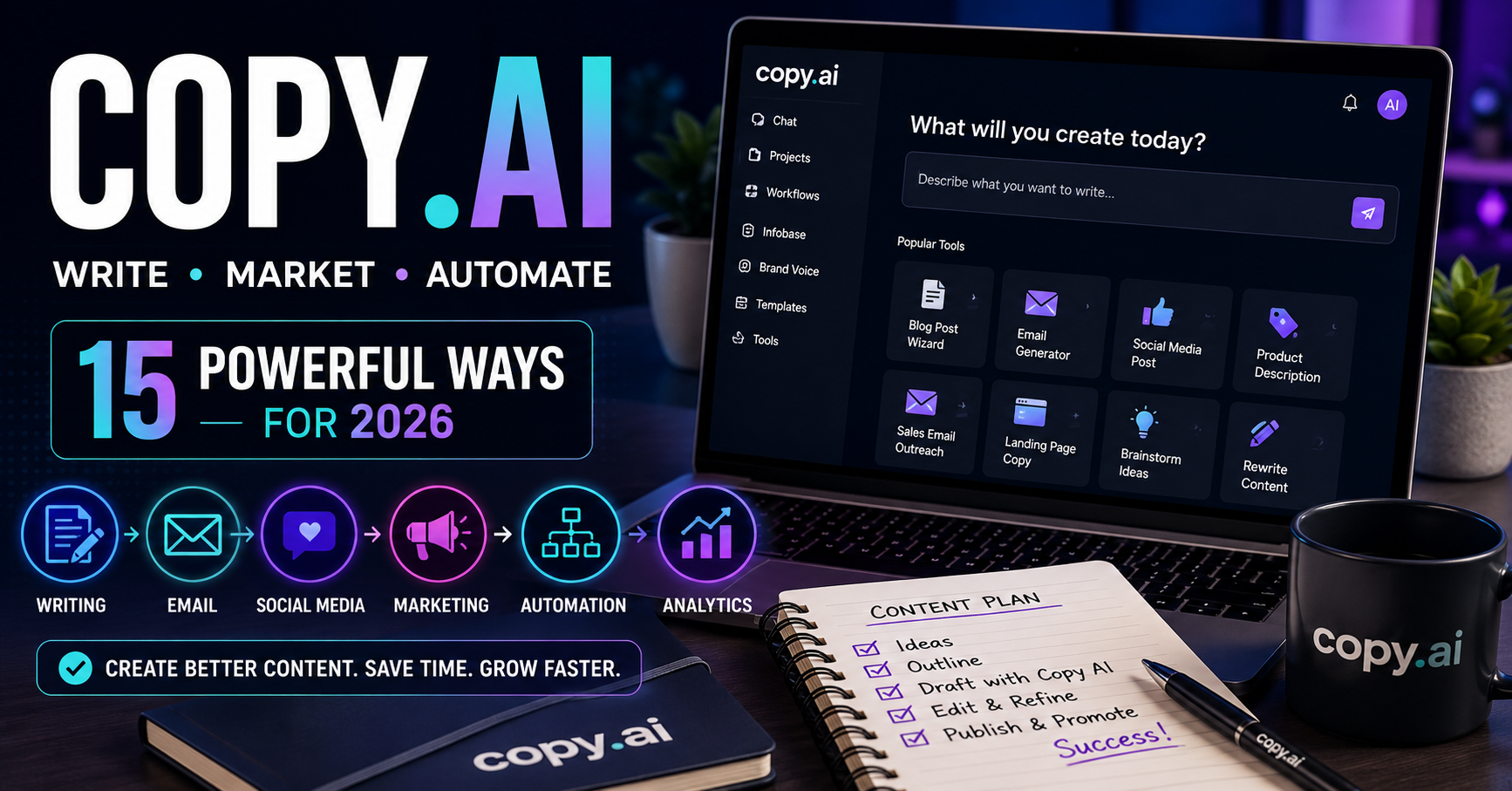
Learning how to use Copy AI can help you create content faster, develop marketing ideas, improve sales messaging, automate repetitive processes, and turn everyday marketing tasks into repeatable AI-powered workflows.
Copy.ai has evolved considerably beyond its earlier reputation as primarily an AI copywriting tool. Today, the platform focuses heavily on go-to-market operations, combining AI-powered content creation with workflows designed for marketing, sales, prospecting, content operations, and other business processes.
For beginners, however, you don’t need to build complicated automation systems immediately.
You can start with simple tasks and gradually explore more advanced features as you become comfortable with the platform.
In this guide, we’ll explore 15 practical ways to use Copy AI in 2026 and look at where the platform can fit into your content, marketing, and productivity workflow.
What Is Copy AI?
Copy.ai is an artificial intelligence platform designed primarily around sales and marketing operations.
While AI-assisted writing remains part of the platform, Copy.ai increasingly emphasizes complete workflows rather than isolated writing tasks. A workflow can take an input and move it through multiple steps to produce useful business outputs.
For example, instead of repeatedly asking an AI assistant to perform individual tasks, businesses can create repeatable processes for things such as content creation, account research, sales insights, prospecting, and thought-leadership content.
This makes Copy.ai particularly interesting for marketers, entrepreneurs, content creators, sales teams, and businesses that want AI to become part of a larger working system.
How Does Copy AI Work?
At its simplest, you provide Copy.ai with information or instructions describing what you want to accomplish.
That could include:
- A topic
- A product description
- Customer information
- A keyword
- An existing piece of content
- Marketing objectives
- Brand information
- Research material
AI then uses those inputs to help generate or process the required information.
For more advanced users, Copy.ai Workflows allow multiple steps to be connected into repeatable processes. Copy.ai describes these workflows as a way of automating complete processes rather than only individual tasks.
Once you understand how to use Copy AI, you can move from simple writing tasks to more structured marketing workflows.
Let’s look at what you can actually do with it.
1. Generate Content Ideas
One of the easiest ways to learn how to use Copy AI is through brainstorming.
Give the AI information about your niche and ask it to generate potential topics.
For example, a small business owner could provide a description of their target customer and ask for:
- Blog ideas
- Newsletter topics
- Social media themes
- Video ideas
- Customer questions
- Educational content
Don’t automatically publish everything AI suggests.
Instead, use the suggestions as starting points and select ideas that genuinely solve problems for your audience.
Learning how to use Copy AI for repurposing can make it easier to turn one strong idea into several pieces of useful content.
2. Create Blog Post Outlines
Starting a long article from an empty page can be difficult.
Copy.ai can help organize a topic into a logical structure before you begin writing.
Provide your main topic, intended audience, and goal.
Then ask for an outline containing an introduction, major sections, supporting points, frequently asked questions, and conclusion.
The resulting outline gives you a framework that you can research, verify, expand, and personalize.
Copy.ai currently promotes AI content workflows that can help automate portions of the content lifecycle, including research and drafting.
3. Draft Blog Content
Once you have an outline, AI can help create a first draft.
This is especially useful when you already know what you want to say but need help turning your ideas into structured writing.
Provide detailed instructions about:
- Audience
- Subject
- Tone
- Purpose
- Important points
- Desired length
The better your instructions and source material, the more useful your starting draft is likely to be.
Always review AI-generated articles before publishing them.
Check factual claims, remove unnecessary repetition, add personal expertise where appropriate, and make sure the final article actually helps the reader.
4. Write Marketing Emails
Email marketing is another useful Copy.ai application.
A major advantage of understanding how to use Copy AI is being able to build repeatable processes instead of starting every marketing task from scratch.
You can experiment with drafts for:
- Welcome emails
- Promotional campaigns
- Product announcements
- Follow-ups
- Newsletters
- Lead nurturing
- Re-engagement campaigns
Rather than simply requesting “write a marketing email,” provide information about the customer and the specific action you want that person to take.
This produces a much clearer objective for the AI.
5. Create Social Media Content
Producing fresh social content consistently can become time-consuming.
Copy.ai can help turn one central idea into several potential social posts.
For example, you could take an existing article and develop shorter content for LinkedIn, Facebook, Instagram, or other appropriate channels.
This is where AI becomes particularly valuable for repurposing.
Instead of developing every piece of content independently, one well-researched article can become the foundation for several smaller pieces.
6. Improve Existing Content
You don’t always need Copy.ai to create something from scratch.
Existing content can also be improved.
You might provide an older paragraph and ask the AI to make it:
- Clearer
- Shorter
- More conversational
- Better organized
- Easier for beginners to understand
- More persuasive
Compare the rewritten version against your original rather than accepting every change automatically.
Sometimes your original wording will still be better.
7. Generate Product Descriptions
Online sellers frequently need descriptions for multiple products.
Copy.ai can help produce initial product copy when you provide accurate information about the item.
Include real specifications, features, intended customer, and important benefits.
AI should help communicate factual product information—not invent features the product doesn’t actually have.
For affiliate marketers, the same principle applies.
Your content should help readers understand the product rather than simply producing exaggerated promotional claims.
8. Create Sales Messaging
Copy.ai isn’t limited to traditional content marketing.
Its current platform places significant emphasis on sales and go-to-market operations.
AI workflows can assist with activities such as account research, prospecting and personalized outreach.
A business could therefore use AI to develop starting drafts for prospecting emails, follow-up messages, value propositions, and other sales communications.
Human judgment remains important, particularly when personalization determines whether a message feels genuinely relevant or like mass-produced spam.
9. Repurpose Long-Form Content
Content repurposing is one of the most practical ways to get more value from work you’ve already completed.
Suppose you’ve written a detailed 2,000-word article.
You could use that article as source material for:
- Social posts
- Email content
- Short summaries
- Talking points
- Promotional copy
- Video concepts
Copy.ai itself emphasizes connected content workflows rather than treating every piece of marketing content as an isolated deliverable.
For small content creators, that philosophy can be extremely useful.
Create something valuable once and find several sensible ways to distribute its ideas.
10. Develop Brand Messaging
AI-generated content can become inconsistent when every session begins with completely different instructions.
That’s why businesses should establish clear messaging.
Define things such as your:
- Audience
- Brand personality
- Core promise
- Products
- Preferred terminology
- Communication style
Then use that information consistently when generating content.
Your goal isn’t for AI to invent your brand.
The brand should come from you. AI simply helps you apply those decisions more efficiently.
11. Research Potential Content Angles
AI can also assist during the early stages of research.
For example, you might ask for different questions customers could have about a topic or alternative perspectives worth investigating.
But there’s an important distinction between research assistance and verified research.
AI-generated information can be wrong.
Important statistics, quotations, prices, product capabilities, dates, and factual claims should be checked against trustworthy sources before publication.
12. Build Repeatable Marketing Workflows
This is where Copy.ai becomes more interesting than a basic writing assistant.
Copy.ai Workflows are designed to automate processes involving multiple steps. The company lists applications including account research, sales insights, SEO content generation, and thought-leadership content.
Think about a task you perform repeatedly.
Instead of manually completing the same sequence every time, consider whether parts of that process can become a standardized workflow.
For example:
Topic → Research → Outline → Draft → Review → Repurposing
The objective isn’t automation simply for the sake of automation.
It’s removing repetitive work while keeping human judgment where it matters.
13. Create Content for Different Funnel Stages
Not every reader is ready to buy something.
Some people have only just discovered their problem.
Others are comparing solutions.
Some are nearly ready to make a decision.
You can use Copy.ai to brainstorm content designed around these different stages.
For example:
Awareness:
Educational beginner article.
Consideration:
Detailed tool guide or comparison.
Decision:
Product review, case study, demonstration, or offer.
This approach can make your content strategy far more purposeful than publishing unrelated articles.
14. Support Affiliate Marketing Content
Affiliate marketers can also use Copy.ai as a production assistant. Affiliate marketers who learn how to use Copy AI effectively can speed up research, outlining, content planning, and promotional preparation.
It can help brainstorm:
- Product review structures
- Comparison criteria
- Tutorial sections
- FAQs
- Email campaigns
- Social promotion
- Calls to action
But don’t allow AI to manufacture personal experience.
If you haven’t personally tested a product, don’t publish AI-generated statements claiming that you did.
Affiliate content becomes much stronger when readers receive useful information that helps them make an informed decision.
15. Turn Content Creation Into a System
The most powerful lesson from learning how to use Copy AI isn’t necessarily learning another AI writing tool.
It’s learning to think systematically.
Instead of:
“I need to write another article.”
Think:
Research → Create → Optimize → Publish → Distribute → Measure → Improve
AI can support several parts of that process.
Copy.ai’s current approach similarly emphasizes connected AI workflows rather than simply generating more isolated pieces of content.
That mindset becomes increasingly valuable as your content library grows.
Is Copy AI Free?
Copy.ai’s plans can change, so always check the company’s current pricing before subscribing.
At the time this article was prepared, Copy.ai’s official pricing page showed a self-serve Chat plan alongside substantially larger business-oriented plans. Features and pricing vary significantly between levels.
Check the current Copy.ai plans and pricing
This is preferable to relying on old articles or videos because AI software pricing changes frequently.
Copy AI vs General AI Assistants
Copy.ai overlaps with general-purpose AI assistants in several areas, particularly writing, brainstorming, and content creation.
The major difference is its emphasis on go-to-market processes and repeatable workflows.
General AI assistants may be more appropriate for broad everyday questions, learning, coding, reasoning, and miscellaneous tasks.
Copy.ai becomes more interesting when your needs center around marketing, sales, content operations, and repeatable business processes.
Neither approach is automatically better.
The right choice depends on the work you’re trying to accomplish.
Who Should Use Copy AI?
Copy.ai may be worth exploring if you’re a:
Content creator who regularly produces marketing material.
Affiliate marketer who needs help organizing and repurposing content.
Small-business owner managing multiple marketing responsibilities.
Marketing professional looking to standardize repetitive processes.
Sales professional working with prospecting and outreach.
Team attempting to introduce AI into larger go-to-market workflows.
Beginners can start with simple content tasks before experimenting with automation.
Advantages of Copy AI
Copy.ai’s biggest potential advantage is that it encourages users to move beyond isolated prompts.
Its workflow-based approach can help businesses create more repeatable processes.
Other potential benefits include faster brainstorming, content repurposing, drafting assistance, marketing applications, and sales-oriented workflows.
However, AI output still requires oversight.
Speed doesn’t automatically produce accuracy or quality.
Limitations of Copy AI
Copy.ai isn’t a replacement for human strategy.
AI-generated material can still contain:
- Incorrect information
- Generic writing
- Repetition
- Weak differentiation
- Inappropriate recommendations
- Outdated information
Advanced automation can also be unnecessary for someone who only occasionally needs AI writing assistance.
Choose tools according to the problem you’re solving rather than simply because they contain more AI features.
How to Get Better Results From Copy AI
Give the AI context.
Instead of writing:
“Write a blog post about AI.”
Try something closer to:
“Create an outline for a beginner-friendly article explaining how small-business owners can use AI to save time. Focus on practical tasks, avoid technical jargon, and organize the article into actionable sections.”
Then refine the result.
Good AI usage is usually iterative.
Your first instruction starts the process rather than finishing it.
Is Copy AI Worth Using in 2026?
Copy.ai is worth investigating if your work involves content marketing, sales, prospecting, or other repeatable go-to-market processes.
Its evolution toward workflows is particularly important.
Instead of viewing AI simply as a machine that generates paragraphs, businesses can use AI as part of a structured system in which information moves through repeatable processes.
Copy.ai’s own recent material increasingly emphasizes this workflow-first model across content and go-to-market operations.
For someone who only needs occasional questions answered, a general AI assistant may be sufficient. The best way to learn how to use Copy AI is to start with one real task, test the results, and gradually expand into more advanced workflows.
But users who regularly create marketing content or want to automate repeatable business processes may find Copy.ai’s approach more compelling.
Final Thoughts on How to Use Copy AI
Learning how to use Copy AI is about more than generating sales copy.
The platform can support brainstorming, content creation, email marketing, social media, sales messaging, content repurposing, research preparation, and increasingly sophisticated AI workflows.
Start small.
Choose one repetitive task and see whether AI can help you perform it more efficiently without reducing quality.
Then experiment with more advanced workflows as your understanding grows.
The goal shouldn’t be to automate everything.
The goal should be to use AI where it genuinely saves time, improves consistency, or helps you produce better work.
For readers interested in another AI platform designed specifically around marketing content, continue with your How to Use Jasper AI guide.
And for readers looking for a wider selection of tools for everyday work, your 7 Best AI Productivity Tools for Beginners article is another useful next step.